ZENSPERA
BUSINESS STRATEGY & DECISION INTELLIGENCE
A multidisciplinary approach to business strategy and decision-making — moving from information to unified decisions.
LIMITATION
Why decision systems fall short in organizations?

- Failures can be structural. Desirable data is not always sufficiently available. Collected data is an outcome of past organisational structures. Markets may move fast. Customer preferences may shift. Regulations may change.
- Information may not improve decisions unless it is structured through a comprehensive, unified business framework that recognises and accounts for all major decisions across business functions.
- Prediction alone is not decision-making. While AI systems (empirical analysis in general) may identify patterns effectively, they do not necessarily translate those insights into the right decisions.
- Strategy is decision architecture. Advantage comes from how decisions are designed rather than from simply optimising isolated empirical analysis outputs.
OUR APPROACH[A Brief Overview]
A structured system for converting information into decisions and strategy.

Build a customized framework
We begin by building a customized, big-picture framework that maps the key decisions and how they are interconnected. This serves as a guide, bringing clarity to diagnostics, the design of analyses, the interpretation of information signals and model outputs, and the formulation of potential solutions.
Extract structure from data
We identify meaningful patterns using empirical methods, focusing on signals that are decision-relevant—not merely observable.
Apply business interpretation
We interpret patterns through the granular framework to transform insights into structured causal understanding.
Convert interpretations into actions
We reflect model outputs and their interpretation across decisions using the framework to design overall strategy.
APPLICATIONS
Where decision intelligence translates into business value

Risk & Uncertainty [A Brief Overview]
Structure uncertainty into decision-ready frameworks that improve robustness, capital allocation, and downside protection.
Decision Design [A Brief Overview]
Align incentives, strategy, and execution into coherent systems that improve decision accuracy and reduce structural inefficiencies.
Customer & Product [A Brief Overview]
Translate consumer behavior and market structure into product design decisions for acquisition, retention, and engagement.
Growth & Pricing [A Brief Overview]
Structure demand, pricing, and revenue decisions to identify sustainable growth levers and improve monetization efficiency.
INSIGHTS & RESOURCES
Integrated frameworks, functional prototypes, and articles across business, data science, and technology.

I. White Papers & Strategic Briefings
Beyond Silos: Building Strategy That Combines Economics, Data Science, and Technology (15-Dec-2025)
In traditional corporate structures, functional teams operate within isolated silos — corporate strategy, data science, and technology each in its own corner. This briefing argues that this separation creates severe structural vulnerabilities. Modern organisations must build an integrated, multidisciplinary strategy function that blends economic reasoning, advanced data science, and technology into a unified decision capability.
Pricing as Strategy: Integrating Economics, Data Science, and Governance for Long-Term Value Capture (22-Dec-2025)
Pricing is one of the most powerful levers of aggregate enterprise profitability, interacting dynamically with variable cost structures, risk profiles, structural demand patterns, competitive positioning, and broader macroeconomics. Operational pricing choices do not merely influence immediate quarterly numbers; they can shape long-term market share, Customer Lifetime Value (CLV), and strategic competitor responses.
Strategic Product Design: Designing Choice Architecture and Managing Feature Trade-offs Under Structural Uncertainty (06-Jan-2026)
Product architecture design is inherently a complex, highly resource-constrained asset allocation problem. Corporate innovation teams face a continuous stream of high-stakes, cross-functional trade-offs: prioritising dense feature pipelines, selecting optimal user cohorts, and allocating scarce design and R&D capital. Product decisions can have substantial opportunity costs and long-term downstream operational risk.
Organisation as an Incentive Structure: Aligning Human Capital, Information Flow, and Decision Architecture (15-Jan-2026)
Modern enterprise organisations track KPIs spanning attrition, engagement scores, sales productivity, and operational risk — yet targeted interventions may routinely yield only temporary performance bumps followed by stagnation. This briefing discusses that this pervasive operational gridlock can stem from a structural failure: an organisation is fundamentally an incentive system. Observed performance gaps may not be isolated capability deficits; they represent stable equilibrium responses to misaligned reward structures.
Risk as an Economic Decision Problem: Bridging Empirical Models and Strategic Action Under Uncertainty (21-Jan-2026)
In modern corporate governance frameworks, business risk metrics may still be treated as narrow, technical outputs of statistical models. This isolated perspective can introduce strategic vulnerabilities. Business risk can arise because forward-looking economic agents must make high-stakes choices under conditions of uncertainty, imperfect information, competitive strategy, and balance sheet constraints.

II. Functional Prototypes & Demos
Economic News Elaborator: Insights Using a Generative AI Stack (30-Oct-2025)
Built end-to-end locally (including fine-tuning) on an 8GB VRAM laptop, uses a 7B language model for local inference without using any API or external orchestration framework. Tech Stack: 7B Local Language Model, QLoRA Fine-tuned on Economics Domain, RAG & Local Vector Database, Ontology-based Retrieval
AI-Powered Research Paper Summarizer (29-Aug-2025)
A GenAI functional prototype. Build locally, uses 7B language models for local inference without using any API or external orchestration framework.

III. Articles & Commentary
Effects of AI Investments on the Economy (09-Dec-2025)
Effects of AI Investments on the Economy: Some Quick, Surface-Level Observations, Comments and Questions. A view from the perspective of frontier players, ecosystem dynamics, labour/productivity and long-term economics.
SERVICES
Capacities built for unified decision intelligence at scale
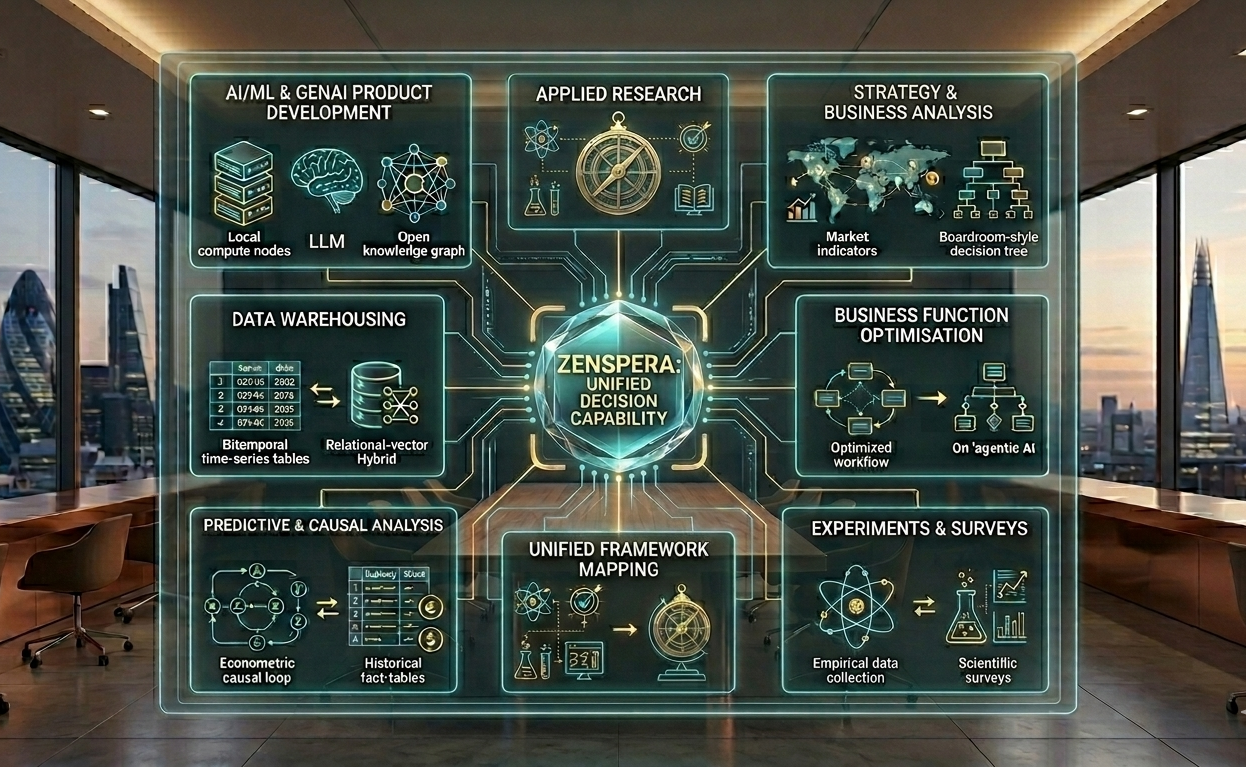
Strategy & Business Analysis
Translating information, empirical insights, and unified business framework into boardroom strategy.
Predictive & Advanced Analysis
Using range of empirical methods to build predictive models and determining cause and effect.
COLLABORATION
Going Beyond Analysis to Unified Decision-Making and Comprehensive Strategy.